Run the loop by hand
Press Step 8 times. Watch col count 0 to 7 while row stays 0. That is the inner loop finishing one row.
Hint: Press Step and watch the variables under the code.
Lessons are being translated. Anything not translated yet appears in English.
Choose a quick fix. Nothing is saved or sent.
Watch a real algorithm run, one brick at a time. A stack of clay bricks in Thailand becomes a grid of 8 × 12 = 96 units, and two loops and an if / else turn it into a song. Press Step to walk the code yourself, or Play to hear the whole wall. Tap any brick to change the data.
← Back to suiteWant to write the rules that build a wall instead? Try Bricklayer Music Man.
Row 1 is the bottom of the wall. Music plays left to right, bottom to top, the same order you would build it.
row–col–wall[row][col]–step–scale[step]–Code counts from 0, so row 0 is the bottom row, labeled 1 on the wall.
58 notes · 38 rests · 96 units
Press Play to hear the wall.
Press Step 8 times. Watch col count 0 to 7 while row stays 0. That is the inner loop finishing one row.
Hint: Press Step and watch the variables under the code.
Look at row 1, the bottom row of our wall. How many units are bricks (notes)?
The wall is 8 units wide and 12 rows tall. How many units are there in all?
Press Our wall, then read the counter under the code. How many notes does our wall play?
Play the wall with 1 brick = 1 beat, then with 1 brick = 1 bar. Same data, a different length of song.
Hint: Press Play in both modes.
Pick a different key and play. The bricks don't move, but the notes change, because the code plays scale[step].
Hint: Change the Key menu, then press Play.
Make any row with 7 or 8 holes. That row becomes a long conga solo.
Hint: Tap bricks in one row until almost all are holes.
Change at least 12 units so the wall is yours, keep at least 30 notes, then play it.
Hint: Tap bricks, check the counter, then press Play.
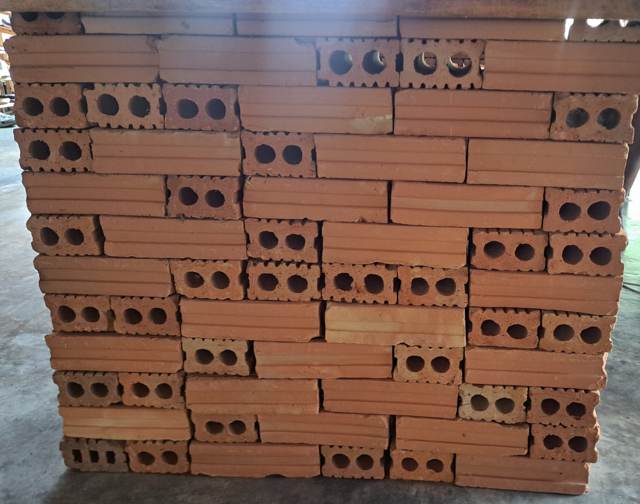
Bricks stacked under a table. Some face out with the long grooved side, some with the end that has two holes.
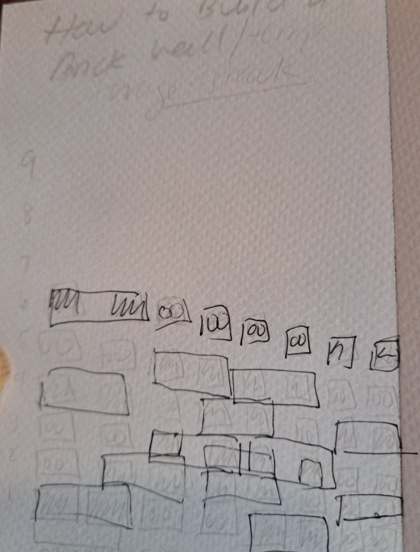
Sketch it row by row. Every row is exactly 8 units wide. A long brick covers 2 units, a hole end covers 1.
row 12  HBBBBBBH
row 11  BBBBHHBB
row 10  HHHBBBBH
row  9  HBBHBBBB
row  8  BBHBBBBH
row  7  HBBHBBHH
row  6  BBHHHHHH
row  5  HHBBBBHH
row  4  BBHBBHBB
row  3  HHBBBBHH
row  2  BBHBBBBH
row  1  HHBBHHBB
Write each row as 8 letters: B for brick, H for hole. Now the wall is a grid a computer can read.
for each row (12)
  for each column (8)
    if B → play a note
    else  → rest
Two loops visit all 96 units. An if / else decides note or rest. That is the whole algorithm.
Wall photo and sketch by Wayne B. A HyperGeek game by Hyper Intelligence, LLC.